Argument binding might be the original sin of sequential thinking, it exists purely to route arguments into operands. Tacit programing removes that indirection by using order instead of names.
Finally, multiset programming gets rid of order itself.

Rejoice is a concatenative programming language in which logic and arithmetic emerge entirely from the application of fractions. Think Fractran, without the rule-searching, or Forth without a stack.
^n denotes multiplicity. For example, the bag [cube cone^3] contains one cube, and three cones. The empty bag is represented as [].[eye ball^2] and [ball eye ball] are equal.owl/cat^2 means to replace two cats with one owl.A program is a sequence of instructions, separated by spaces, written in the postfix notation. Each instruction is a fraction that corresponds to an exchange of resources on a list of unsorted symbols. The caret notation is used to represent multiple instances of a symbol. For example, x^5 indicates five instances of x. The empty bag [] is identity; x/[] always applies, and []/x only applies when x is found in the bag.
3 4 + 2 - . ( In Forth )
n^3 n^4 /n^2 .#n( In Rejoice )
Evaluation consists of applying each fraction in a sequence, when the contents of the denominator are found in the bag: these are removed from the bag and the contents of the numerator are added to the bag; otherwise the fraction is skipped having had no effect.
[cat bat rat^2]      ( I have 1 cat, 1 bat and 2 rats )
    [cat bat^3]/rat  ( If I have 1 rat, I replace it with 1 cat & 3 bats )
    /[rat cat^2]     ( If I have 1 rat and 2 cats, I discard them )
    owl/bat^cat      ( If I have at least as many bats as cats..
                          .. I replace the amount of cats in bats with 1 owl )
[bat^4 owl]          ( I am left with 4 bats and 1 owl )
Execution walks through the program in order, each instruction is attempted and the program halts when the program counter reaches the end of the program.
Logic is implemented by sequencing fractions for each possible state of the gate. The fractions consume a dedicated symbol, which we'll call a sentinel, to ensure only one clause fires. For example, here is the implementation of a NOT logic gate:
false not
	true/[not false]
	false/[not true]
[false not] true/[not false]
[true] false/[not true]
[true]
The different cases are sequenced one after the other, here is a OR gate. Note the need for a sentinel symbol, or, that persists through each case, without which, the false case could not be reached.
x y or
	true/[or x y]
	true/[or x]
	true/[or y]
	false/or
Lastly, here is an AND gate which also needs a sentinel symbol to capture the state when both inputs aren't present in the bag.
x y and
	true/[and x y]
	false/[and x]
	false/[and y]
	false/and
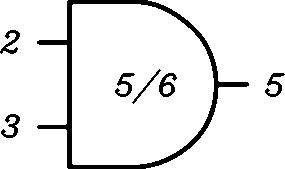
In Fractran, a fraction is a constant, but in Rejoice, a fraction is resolved against the bag when it is evaluated, so the same fraction can be a different ratio every time. When a symbol is used as an exponent, its value is the number of instances of that symbol in the bag at that moment, or zero when it is absent. For example, a fraction containing x^y, the value of y is read as the number of instances of the symbol y in the bag resolved when the fraction is evaluated. The fraction [a a^x]/b can be thought of as a^(1+x)/b.
For example, to find the sum of two values, the program creates as many instances of x as there are of y, and then drain the left-over instances of y:
x^2 y^5 add
	x^y/[add y^y] ( Copy ys onto x, drain ys: )
[x^2 y^5] x^y/y^y
[x^7]
To find the difference between two values, the program removes as many instances of x as there are of y:
x^5 y^2 sub
	/[sub x^y y^y] ( Remove as many xs as there are ys, drain ys: )
[x^5 y^2 sub] /[sub x^y y^y]
[x^3]
All variable exponents within a single bracket are resolved in parallel simultaneously against an atomic read of the bag. No symbol inside a bracket can observe the effects of any other symbol in the same bracket. For example, a single fraction can find whether x is equal to y:
x^6 y^6 equ?
	true/[equ? x^y y^x] ( Fire when x and y are equal, drain both: )
[x^6 y^6 equ?] true/[equ? x^y y^x]
[true]
( a -- true|a ) true/nil^a( a b -- true|[a b] ) true/[a^b b^a]( a b -- [true a^diff]|[a b] ) true/[a^b b^b]( a b -- min^b|min^a ) min^b/[a^b b^b] min^a/[b^a a^a]( a b -- max^a|max^b ) max^a/[a^b b^b] max^b/[b^a a^a]
Picked by Cantor for the first infinite ordinal number, infinity is expressed as the letter Omega, ω. It indicates the limit of the sequence of natural numbers 1, 2, 3, 4.. For example, apple^ω means an infinity of apples. Infinity is a saturating value, no finite quantity can be added to or removed from it.
x^ω x         =  x^ω      ( No quantity may be added to infinity )
x^ω /x        =  x^ω      ( No quantity may be removed from infinity )
x^ω x^ω       =  x^ω      ( Infinity and infinity makes infinity )
x^ω y^x       =  x^ω y^ω  ( Infinity can spread )
x^ω /x^ω      =  []       ( Infinity can be removed from infinity )
x^ω y^ω /x^y  =  y^ω      ( An exponent that reads ω is ω )
Adding infinity to infinity also equals infinity. To remove an infinity from the bag, the size to remove must also be that of infinity, this deviates from Cantor's infinity which is undefined. In a 16-bit Rejoice system, infinity is any number equal or higher than 32767.
For example, here is how to use the infinity saturation to clamp a value:
hp^18        ( You have 18/25hp )
hp^10        ( Take a potion, add 10hp )
hp^ω/hp^25   ( Clamp hp at 25 )
hp^25/hp^ω
[hp^18] hp^10
[hp^28] hp^ω/hp^25
[hp^ω] hp^25/hp^ω
[hp^25]
( a -- a^a|a^ω ) a^ω/aRejoice has a system for catching the absence of something. A denominator of nil^apple is a request for an apple amount of nils to be removed, which is only satisfied by the absence of any apple symbol in the bag.
orange
	no-oranges/nil^orange
	no-apples/nil^apple
[orange] no-oranges/nil^orange
[orange] no-apples/nil^apple
[orange no-apples]
A common operation is to loop over a fraction until exhaustion. Anonymous functions are syntactic sugar so that fractions that are repeatedly applied until exhaustion don't need to be named. For example, here is a program to find the quotient:
x^24 y^6 'res/x^y
[x^24 y^6] 'res/x^y
[x^18 y^6 res] 'res/x^y
[x^12 y^6 res^2] 'res/x^y
[x^6 y^6 res^3] 'res/x^y
[y^6 res^4] 'res/x^y
[y^6 res^4]
The Fibonacci numbers can be found with a single anonymous function, by swapping x and y while a counter n is present:
n^6 y ( n y -- n.fib y )
	'[y^x x^y]/[x^x n]
[n^6 y] '[y^x x^y]/[x^x n]
[n^5 y x] '[y^x x^y]/[x^x n]
[n^4 y^2 x] '[y^x x^y]/[x^x n]
[n^3 y^3 x^2] '[y^x x^y]/[x^x n]
[n^2 y^5 x^3] '[y^x x^y]/[x^x n]
[n y^8 x^5] '[y^x x^y]/[x^x n]
[y^13 x^8] '[y^x x^y]/[x^x n]
[y^13 x^8]
( x y -- x r=x*y ) 'r^x/y( x y -- y r=x/y ) 'r/x^y( x y -- x=x%y y ) '/x^yA @label is a special syntax that represents position in the program. After each instruction, if a symbol matching the name of an existing label is present in the bag, the symbol is consumed, and execution jumps immediately to that label position. The capitalization of labels is merely a convention. For example, here is a program to find the product:
x^2 y^3

@Mul ( x y -- res )
	[Mul res^x]/y
[x^2 y^3] [Mul res^x]/y
[x^2 y^2 res^2] [Mul res^x]/y
[x^2 y res^4] [Mul res^x]/y
[x^2 res^6] [Mul res^x]/y
[x^2 res^6]
When two labels enter the bag at the same time, one is picked at random. For example, a program that returns the result of a coin toss:
( flip a coin ) [Head Tail]

@Head head End
@Tail tail
@End
Symbols that start with . will be emitted as text and immediately removed from the bag. Symbols that start with .# will emit the number of instances of that symbol in the bag. For example: A token like .hello^3 will emit hellohellohello.
pigs^3
	( print the word "pigs:" ) .pigs:
	( print the number of pigs in decimal ) .#pigs
pigs:3
The supported escape sequences are: \t(tab), \s(space) and \n(linebreak). Input is done by adding special symbols in the bag before evaluation.
And lastly, this would not be complete without an example of FizzBuzz:
@Loop ( -- f b )
	[num f b]
	End/num^100
		[Loop .FizzBuzz\n]/[f^3 b^5]
		[Loop .Fizz\n]/f^3
		[Loop .Buzz\n]/b^5
		[Loop .#num .\n]
	@End
1, 2, Fizz, 4, Buzz, Fizz, 7, 8, Fizz, Buzz, 11, Fizz, 13, 14, FizzBuzz ..
Argument binding might be the original sin of sequential thinking, it exists purely to route arguments into operands. Tacit programing removes that indirection by using order instead of names.
Finally, multiset programming gets rid of order itself.
To dive deeper, have a look at the Rejoice devlog.
[] es nihil, identitat. /n es predecesor.
n es sucesor.

incoming: pocket fractions left multisets notation tropical arithmetic paper computing wdr computer concatenative rejoice devlog gaud fractran bagel oscean 2026