
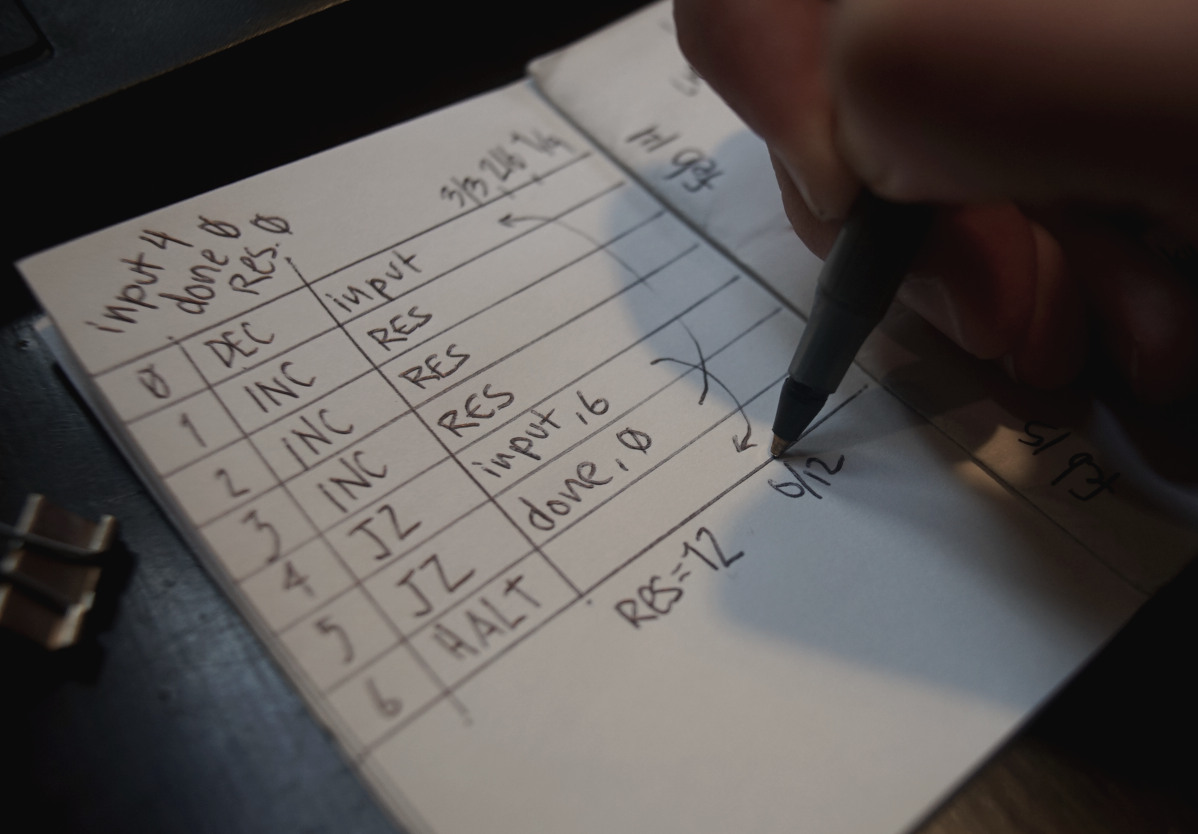
Register Machine Emulator
The pen, representing the program counter, is positioned at the first line of the program. The instruction on that line is processed by modifying the value of a register, or checking if a register is Zero and then moving to the next instruction. The evaluation stops upon reaching a halt or empty instruction.
CLR(r): Set register r to Zero.INC(r): Add 1 to the register r.DEC(r): Subtract 1 from register r.CPY(a, b): Copy the register a in register b.JZ(r, i): If register r is Zero, jump to instruction i.JE(a, b, i): If the registers a and b are equal, jump to instruction i.
The classic paper ISAs are the WDR Computer and CARDIAC.
WDR Instruction Set
The WDR paper computer, or Know-how Computer, is an "educational model" of a computer consisting only of a pen, a sheet of paper, and individual matches in the most simple case. The instruction set of five commands is small but Turing complete and enough to represent most mathematical functions.
With such a restricted instruction set, it's in a similar tarpit as Subleq and Brainfuck, and make for a poor educational model. A better candidate is the CARDIAC.
| Opcode | Description |
|---|---|
| END | Aborts the execution of your program, so that you can examine the contents of your registers. |
| SKP(r) | Checks if the register r is zero. If it is zero, the program counter is increased by 2, otherwise the program counter is increased only by 1. |
| JMP(z) | Sets the program counter to line number z. |
| INC(r) | Increments the contents of the register r and increases the program counter by 1. |
| DEC(r) | Decrements the contents of the register r and increases the program counter by 1. |
The instructions can be encoded as a Rejoice program:
To encode a WDR program into a 8-bits punched card, we could use 3 bits of space to encode the operation, which leaves 5 bits for the value. This computer's programs uses only 5 operations out of a possible 8, leaving 3 unused.
| Binary | Opcode | ||
|---|---|---|---|
| 0 | 0 | 0 | END |
| 0 | 0 | 1 | SKP |
| 0 | 1 | 0 | JMP |
| 0 | 1 | 1 | ADD |
| 1 | 0 | 0 | SUB |
The following program subtracts from R1 and adds to
R0 until the value of R1 is zero. The result of the
addition of R0 and R1 will be stored in
R0.
| Line | Opcode | Value | Opcode | Hex | ||||||
|---|---|---|---|---|---|---|---|---|---|---|
| 00 | 0 | 1 | 0 | 0 | 0 | 0 | 1 | 1 | JMP 03 | $43 |
| 01 | 0 | 1 | 1 | 0 | 0 | 0 | 0 | 0 | ADD R0 | $60 |
| 02 | 1 | 0 | 0 | 0 | 0 | 0 | 0 | 1 | SUB R1 | $82 |
| 03 | 0 | 0 | 1 | 0 | 0 | 0 | 0 | 1 | SKP R1 | $22 |
| 04 | 0 | 1 | 0 | 0 | 0 | 0 | 0 | 1 | JMP 01 | $41 |
| 05 | 0 | 0 | 0 | 0 | 0 | 0 | 0 | 0 | END | $00 |
The binary expression of the operation and value of the previous program can be encoded horizontally as the following punched card:
	v   v   v   v   v   v
			•
	•   •           •
		•       •


	•
	•       •   •   •
Ref. 5-bits Table
The following table show the binary table for 32 addressable lines of a program.
| 00 | 00000 | 08 | 01000 | 10 | 100000 | 18 | 11000 |
| 01 | 00001 | 09 | 01001 | 11 | 100001 | 19 | 11001 |
| 02 | 00010 | 0A | 01010 | 12 | 100010 | 1A | 11010 |
| 03 | 00011 | 0B | 01011 | 13 | 100011 | 1B | 11011 |
| 04 | 00000 | 0C | 01100 | 14 | 100000 | 1C | 11100 |
| 05 | 00001 | 0D | 01101 | 15 | 100001 | 1D | 11101 |
| 06 | 00010 | 0E | 01110 | 16 | 100010 | 1E | 11110 |
| 07 | 00011 | 0F | 01111 | 17 | 100011 | 1F | 11111 |
CARDIAC Instruction Set
CARDIAC (CARDboard Illustrative Aid to Computation) is a learning aid developed for Bell Telephone Laboratories in 1968 to teach high school students how computers work. The computer operates in base 10 and has 100 memory cells which can hold signed numbers from 0 to 999. It has an instruction set of 10 instructions which allows CARDIAC to add, subtract, test, shift, input, output and jump.
| Opcode | Instruction | Description |
|---|---|---|
| HRS x | Halt and reset | Move bug to the specified cell, then stop program execution. |
| CLA x | Clear and add | Clear the accumulator and add the content of a memory cell to the accumulator. |
| STO x | Store | Store the content of the accumulator into a specified memory cell. |
| ADD x | Add | Add the content of a memory cell to the accumulator. |
| SUB x | Subtract | Subtract the contents of a specified memory cell from the accumulator. |
| SFT xy | Shift | Shifts the accumulator x places left, then y places right, where x is the upper address digit and y is the lower. |
| JMP x | Jump | Jump to a specified memory cell. The current cell number is written in cell 99. This allows for one level of subroutines by having the return be the instruction at cell 99 (which had '8' hardcoded as the first digit. |
| TAC x | Test accumulator content | If the content of the accumulator is less than 0, jump to a specified memory cell. |
| I/O | ||
| INP | Input | take a number from the input card and put it in a specified memory cell. |
| OUT | Output | take a number from the specified memory cell and write it on the output card. |
Devine's Gyo
The instruction set can be slightly improved by removing the need for the INP and OUT opcodes by mapping INP to the memory cell 98 and OUT to 100. Another valuable modification to the instruction is to add an addressing mode which adds the power of indirection to the CARDIAC:
- label, i is the value in the cell label[i].
Here is a little program that prints the characters in a string using the extra addressing mode:
	CLA zero       ; Load 0 in accumulator.
	STO i          ; Set value of accumulator into i.
loop
	CLA text, i    ; Load text[i] in accumulator.
	TAC end        ; Jump to end if -1.
	STO 100        ; Write to Output.
	CLA i          ; Load i in accumulator.
	ADD one        ; Add i+1 in accumulator.
	STO i          ; Store i+1 in i.
	JMP loop       ; Jump to loop.
end
	HRS            ; Stop.

zero 0
one  1
i    0
text H e l l o -1
incoming: paper rewriting